The short answer
Waya and Niqati are both loyalty-card platforms built for Saudi merchants: customers add a card to Apple Wallet or Google Wallet, no separate app required. The real difference isn't whether either one works — it's where each one draws its line. Waya's free plan runs to 100 customers and 100 wallet messages a month, publishes an exact geofence radius, and adds scheduled campaigns that respect a shop's working hours. The other platform's free plan stops at 50 customers, and its top tier lists a Foodics, Shopify, and public-API connection that Waya does not offer.
If a live connection to your point-of-sale system is the first thing on your list, that alone decides it before price does. If it isn't, the comparison comes down to how long your free runway lasts and how much detail each vendor publishes about its notifications — both covered below, criterion by criterion, as of September 2026.
What actually decides it
Eight facts settle most of this decision. Here is what each one actually changes for a shop running weekly promotions and watching every riyal before it's proven the card works:
- Free plan size — how many customers you can enroll before paying anything.
- Cheapest paid plan — the monthly number once you outgrow free.
- Wallets — whether both Apple Wallet and Google Wallet customers are covered.
- Customer app — whether your customer has to download anything at all.
- Notifications — how detailed the automated messages and geofencing are.
- Integrations — what software already running in your shop can feed the card.
- Language — whether the product and the card are built Arabic-first.
- Pricing currency — whether every tier is published in SAR or still needs a quote.
How enrollment and stamping work
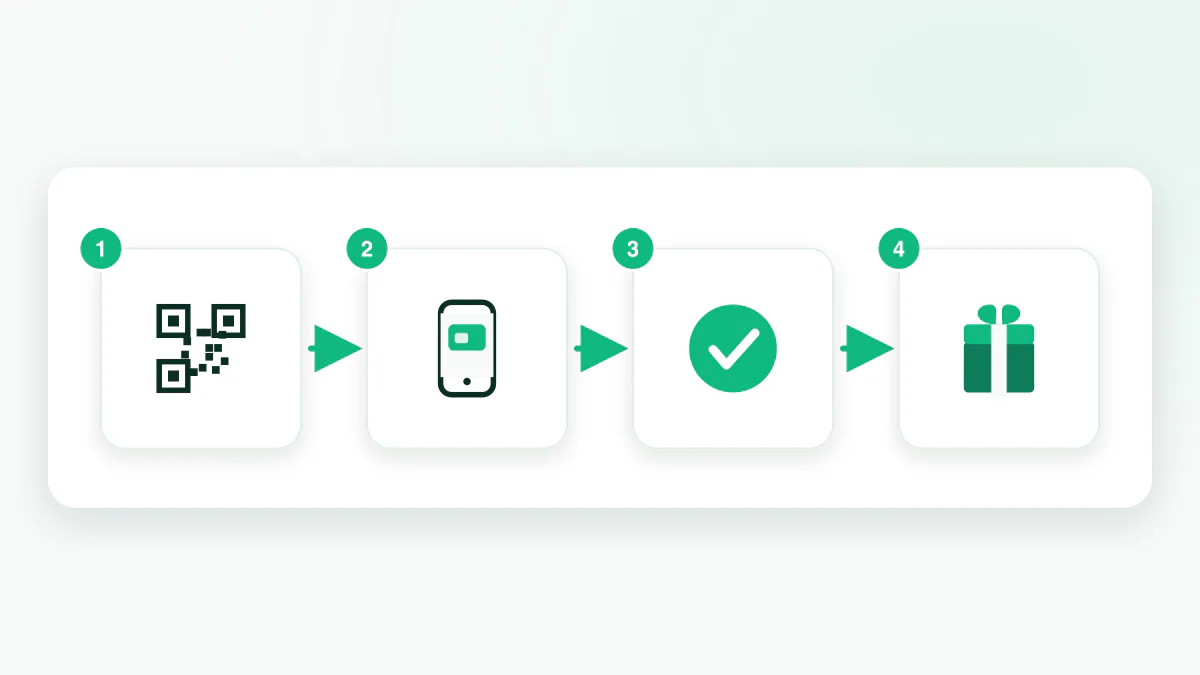
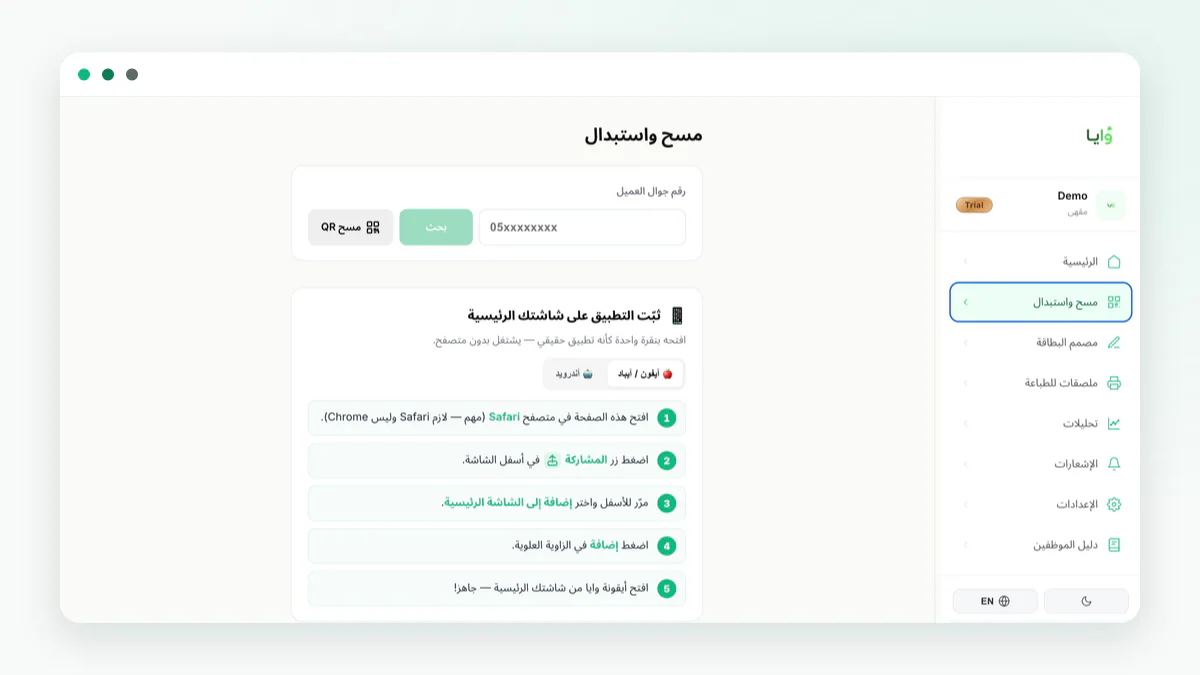
On Waya, a customer scans a QR code on a poster or table tent, types a first name and a mobile number, and taps once to add the card — it lands in Apple Wallet or Google Wallet in seconds, with no account to create and no password to remember. On every return visit, staff scan that same card from an ordinary phone (the web dashboard, or the Waya iPhone app; the Android merchant app is in early access) and the stamp, point, or cashback balance updates on the card automatically.
Niqati's own site describes the same shape of flow — add to wallet via a QR code or link, in under five seconds by its own account. On that specific step, scanning in, the two products are close to a tie; the differences show up later, in what each one does with the customer once they're enrolled.
What each plan costs
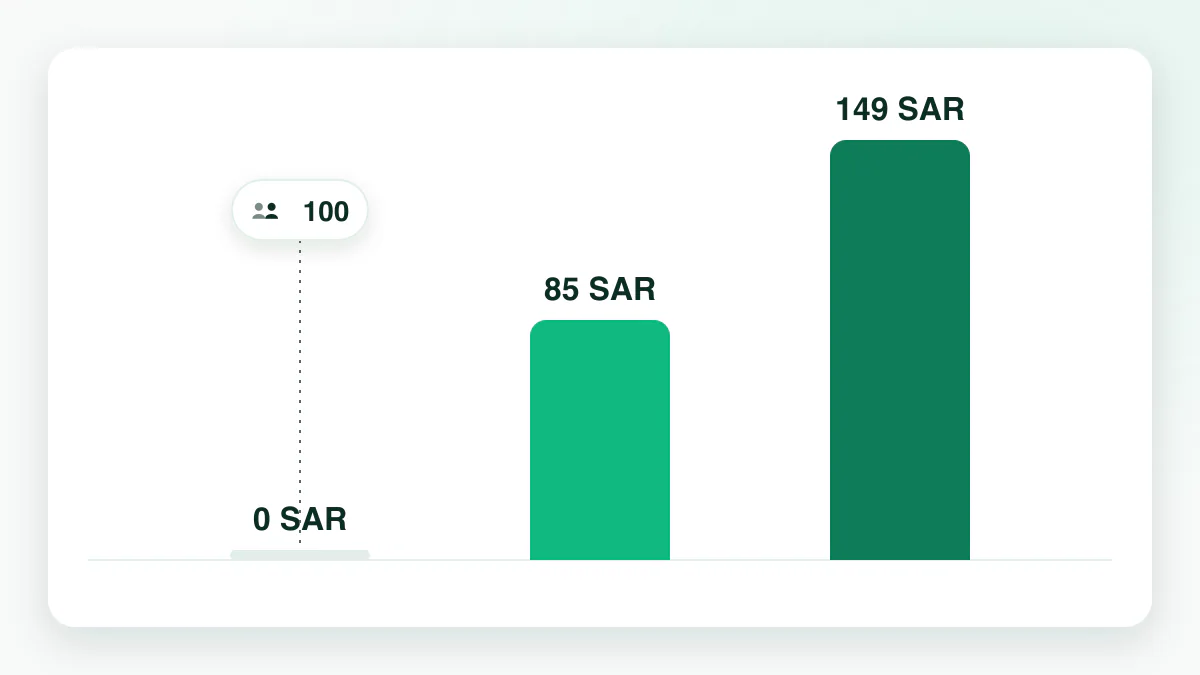
Waya has three published plans, all in SAR, all listed on the same pricing page: Free (0 SAR forever, up to 100 customers, 1 stamp card, 1 branch, 100 wallet messages a month), Growth (85 SAR a month or 867 SAR a year, unlimited customers, up to 10 cards, 3 branches, 5 staff accounts, 5,000 messages a month), and Premium (149 SAR a month or 1,520 SAR a year, unlimited everything plus accounting and POS integrations). None of the three charge a commission on sales, a setup fee, or a per-customer fee. See the full pricing breakdown for exactly what unlocks at each tier.
Niqati publishes two of its three tiers the same way: Free Forever (0 SAR, 1 card, up to 50 customers) and Pro (49.99 SAR a month or 499.99 SAR a year, unlimited cards and customers, a 14-day free trial with no credit card). Its third tier, Enterprise, is quote-based rather than a published number — get that figure and its contract length in writing before comparing it to anything, since only that tier adds multi-branch management, a public API, and point-of-sale integrations.
At the scale most small single-branch shops actually run — a few hundred customers, one location — the other platform's Pro tier is the cheaper sticker price of the two paid options here. Waya's advantage sits on the free side of the line: roughly twice the customer runway before either vendor asks for a card on file.
Does your customer need to install anything?
No, on either platform. The card lives inside a wallet app your customer already has — Apple Wallet on iPhone, Google Wallet on Android — added by scanning a QR code or opening a link, with a first name and a mobile number as the only information asked for. There's no account to create, no password to remember, and nothing to download from an app store.
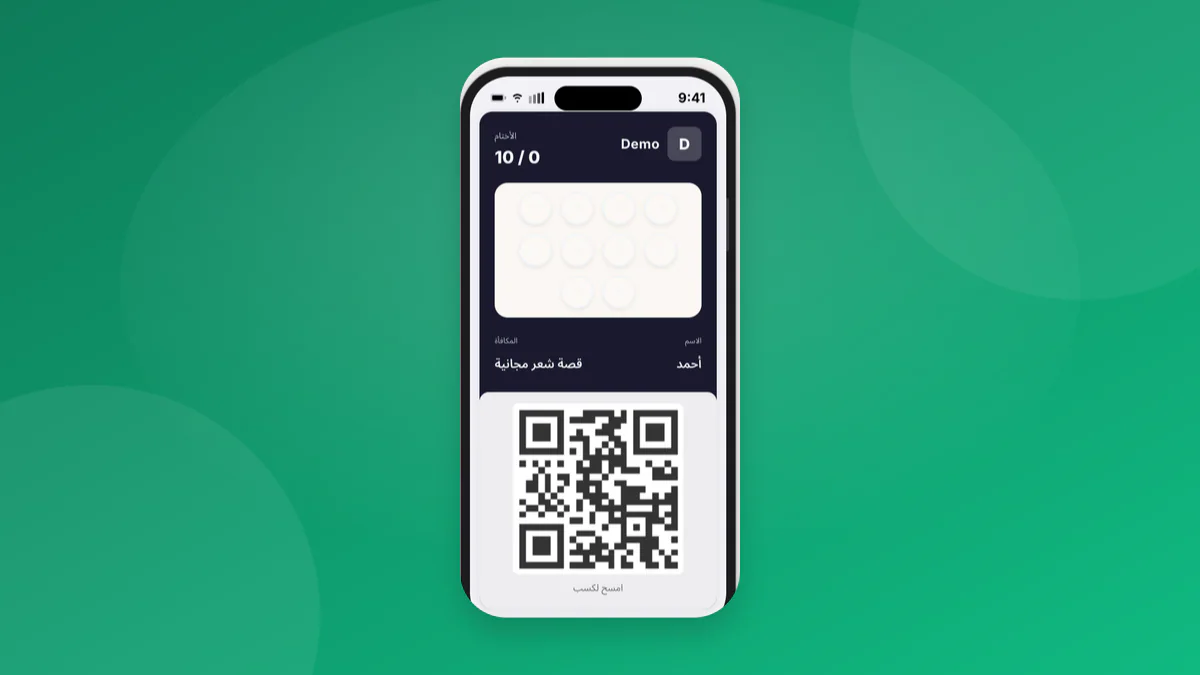
Where the two differ is what happens after the card is added, not the adding itself. Waya's card updates automatically every time a stamp, point, or cashback balance changes, and a lock-screen notification can accompany that update. Whether the other platform's card updates the same way in day-to-day use isn't detailed on its site beyond the general claim that both wallets are supported.
Notifications, compared in detail
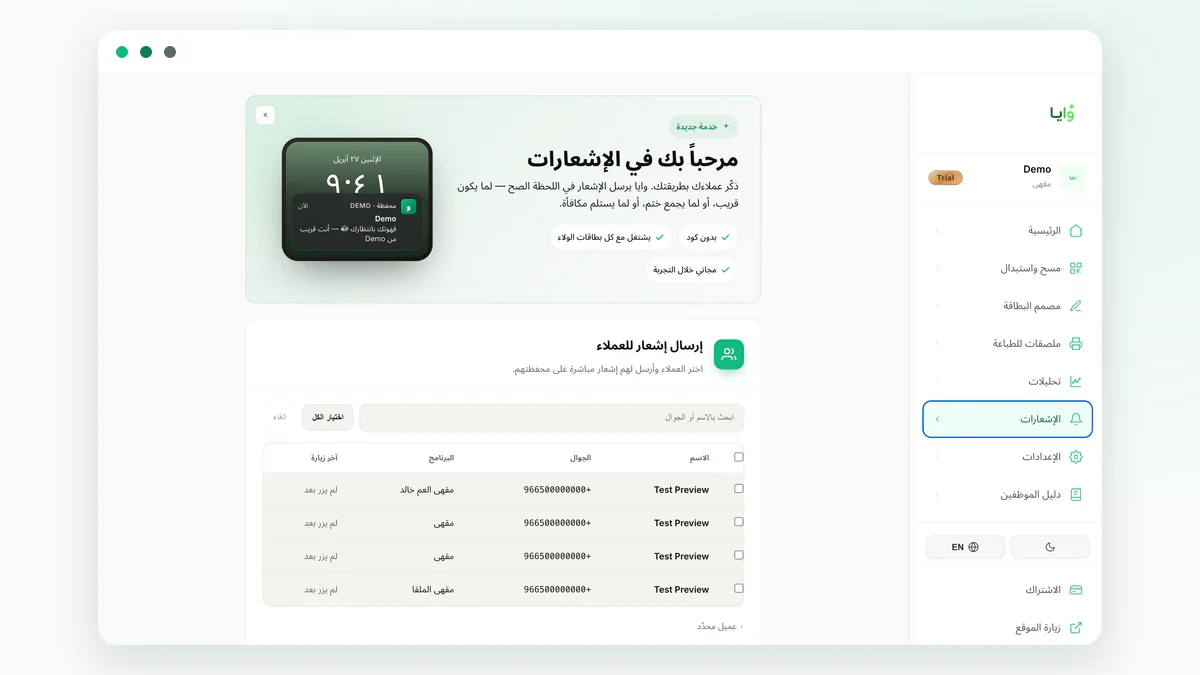
This is where the two platforms publish the most different amount of detail. Waya states an exact geofence radius — 50 to 500 meters, configurable per branch, across up to 10 branches — and four named automatic triggers: a welcome message, a stamp-added confirmation, a reward-ready alert, and an automatic win-back message after 14 days of no visits. Scheduled broadcast campaigns respect the shop's working hours, so a message queued for 3 a.m. moves to the next open slot instead of sending overnight.
Niqati's site claims a "Geo-Aware" notification feature without publishing a radius or a branch count, and describes automated triggers only in general terms rather than as a named, itemized sequence — as of September 2026 there's no public confirmation of a matching win-back message or a working-hours schedule. Its customer segmentation is a simpler three-way split (all customers, inactive customers, or one selected customer), against Waya's four levels (everyone, a lifecycle segment, a specific program, or hand-picked customers). Neither platform publishes a numeric monthly message cap the same way: Waya counts messages by plan (100 free, 5,000 on Growth, unlimited on Premium, with a 500-message top-up for 5 SAR), while the other platform states no numeric limit but rate-limits sending to 10 campaigns an hour.
Choosing by business type
The right card type depends on what you sell more than which vendor you pick. A café or barbershop with a fast, cheap repeat purchase usually does best on a stamp card — buy nine coffees, the tenth is free. A salon or clinic with higher-ticket, less frequent visits tends to do better on a points card, where the reward threshold can track total spend rather than visit count. A shop that already runs store credit or gift balances is a natural fit for a cashback or balance card.
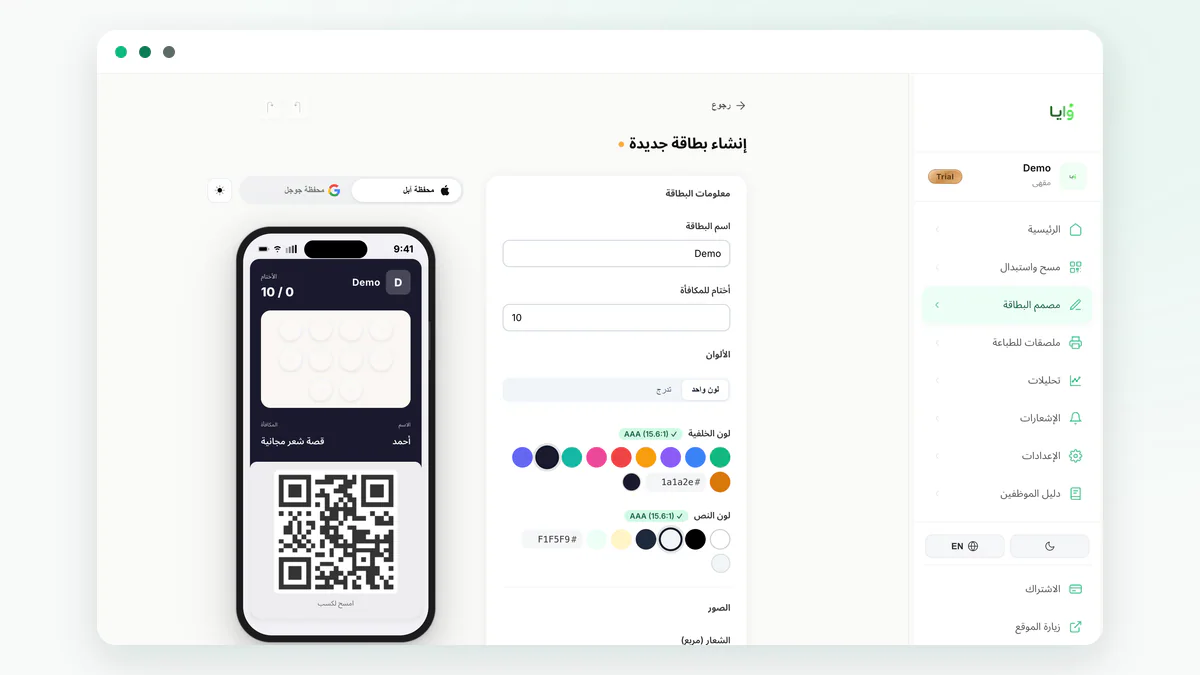
Waya's card designer lets you set the card type, colors, and reward threshold from one screen, with a live phone preview as you adjust it. Whichever platform you end up choosing, picking the card type before you print a single QR poster saves a redesign later — changing the reward math after customers are already mid-card confuses the ones closest to earning something.
Mistakes that kill a program in the first two months
The single most common failure isn't the software — it's the counter. One Waya car wash enrolled 67 cards but saw only about 7.5% return, because staff were not scanning every visit — the lesson is scanning discipline: a card that doesn't get scanned doesn't earn a stamp, and a customer who doesn't earn a stamp has little reason to come back for a tenth wash. The fix is a habit change, not a different vendor — make the scan as automatic as taking payment.
By contrast, one Waya salon enrolled 265 customers; 71 came back two or more times (about 27%), with the same product, because scanning was part of the checkout habit from day one. The typical return rate on Waya sits at about 29% platform-wide when that habit holds. The other common mistake is picking a reward threshold nobody reaches: nine stamps for a free service that costs the shop more than the average ticket trains staff to under-promote the card, on any platform.
Where Waya fits, and where it doesn’t
Waya fits a shop that wants to start at 0 SAR, run Arabic-first cards priced in SAR, and get lock-screen notifications with a published geofence radius and working-hours scheduling. On Premium, it connects to seven accounting and POS platforms — Daftra, Qoyod, Loyverse, Zoho Books, Wafeq, Odoo, and Rewaa — turning a paid invoice above a set amount into an automatic stamp, matched by phone number. See the Daftra integration guide for exactly how that stamp gets triggered.
It does not fit a shop whose main requirement is a live Foodics, Shopify, or WooCommerce connection, or a public REST API: Waya does not offer any of those, and Niqati's quote-based Enterprise tier is built specifically around them. Waya also doesn't send SMS — every message goes to the wallet lock screen — and doesn't integrate with a till or POS terminal directly; staff scan the customer's card from an ordinary phone instead. Before signing anything, run it past this vendor evaluation checklist.
Launching in one week
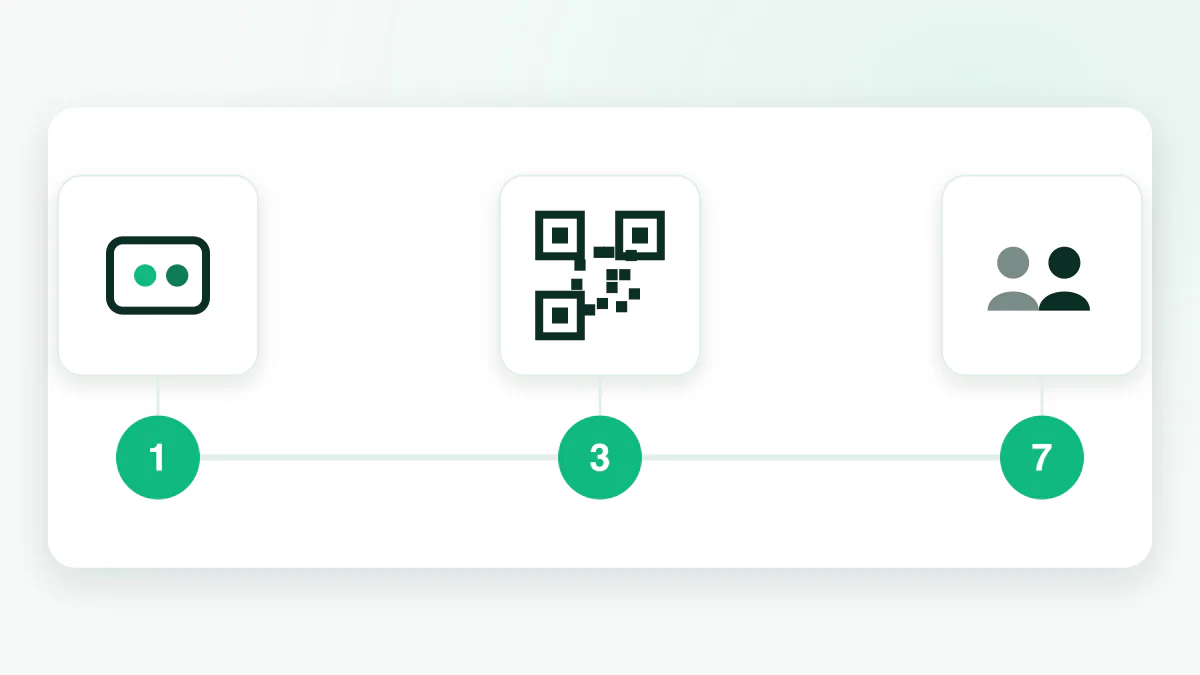
Both platforms offer a genuinely free way to start, so there's no reason to decide from a pricing page alone. Here's how to run a real one-week trial on Waya specifically.
- Day 1: build the card
Pick stamps, points, or cashback, set the reward threshold and colours — it's live in minutes on the free plan, no credit card.
- Day 2: print the QR poster
Export a table-tent or counter-card design straight to PDF from the dashboard and put it where the cashier already stands.
- Day 3: brief the cashier
Add one line to the checkout script — "want a free coffee on your tenth visit?" — and show them where the scan button lives.
- Day 5: check the notification
Send yourself a welcome message and a test stamp to see exactly where, and how fast, it actually lands on your own phone's lock screen.
- Day 7: count enrollments and decide
Compare how many customers scanned in against your foot traffic that week, then decide whether to keep going or try the other platform's trial too.
The fact table
Every figure below is what each vendor's own site states, as of September 2026. Where the other platform's site doesn't state a number, the table says so instead of guessing.
For the wider field of Saudi loyalty vendors, see the full best-of comparison.
| Criterion | Waya | Niqati |
|---|---|---|
| Free plan | 0 SAR forever, up to 100 customers, 1 stamp card, 1 branch, 100 messages/month | 0 SAR (Free Forever), 1 card, up to 50 customers |
| Cheapest paid plan | Growth: 85 SAR/month (867 SAR/year) | Pro: 49.99 SAR/month (499.99 SAR/year) |
| Wallets | Apple Wallet + Google Wallet + web card fallback | Apple Wallet + Google Wallet; web fallback not stated |
| Customer app required | None | None |
| Notifications | Geofence 50–500 m, up to 10 branches; 4 named triggers; working-hours scheduling | Geo-Aware geofence claimed, radius not published; triggers described in general terms; working-hours scheduling not found |
| Integrations | 7 accounting/POS platforms on Premium (Daftra, Qoyod, Loyverse, Zoho Books, Wafeq, Odoo, Rewaa); no Foodics, Shopify, or POS-terminal link | Foodics, Odoo, Shopify, and a public REST API on its quote-based Enterprise tier; no accounting integrations named |
| Language | Arabic-first, bilingual cards | Arabic and English |
| Pricing currency | SAR; all three plans published | SAR; Free Forever and Pro published, Enterprise is quote-based |
Frequently asked questions
Is Waya cheaper than Niqati?
It depends on the tier. Niqati's Pro plan is 49.99 SAR a month, cheaper than Waya's Growth at 85 SAR a month, but Waya's free plan runs to 100 customers against its 50 — so Waya stays free for roughly twice as long before either cost applies.
Do I need an app to use either platform?
No — both Waya and Niqati add a card to Apple Wallet or Google Wallet without any app download. Your customer scans a QR code, adds the pass, and that's the whole install.
What happens on Waya's free plan after 100 customers?
New enrollments and new wallet messages pause once you hit 100 customers or 100 messages in a month, until you upgrade to Growth or Premium. Everyone already enrolled keeps their card and keeps collecting stamps.
Does Waya integrate with a point-of-sale terminal?
No — Waya does not integrate with a POS terminal or till, and does not connect to Foodics; staff scan the customer's card from an ordinary phone instead. On Premium, though, Waya connects to seven accounting and POS platforms — Daftra, Qoyod, Loyverse, Zoho Books, Wafeq, Odoo, and Rewaa — so a paid invoice above a set amount can add the stamp automatically. If a live Foodics connection is what you need, that's on Niqati's quote-based Enterprise tier, not on Waya.
Can I move from another platform to Waya without losing my customers?
You can bring your own customer list to message directly, but there's no bulk or Excel import on Waya — none exists. Message your list the enrollment link before you cancel your old vendor, and put a QR code at the counter for everyone else; each customer re-enrolls with one scan.
Is either platform Saudi-based?
Yes, both are. Waya is Saudi-built, and Niqati is a Saudi company headquartered in Jeddah — both price in SAR and publish Arabic interfaces, as of September 2026.
Which one publishes more detail about its notifications?
Waya does: it states an exact geofence radius (50–500 meters), a 10-branch limit, and four named automatic triggers including a 14-day win-back message. The other platform describes similar features in general terms but doesn't publish the same level of detail, as of September 2026.